As organizations develop more environmentally responsible products, understanding how materials break down in marine environments is an important part of evaluating their environmental fate. Ingredients used in personal care products, detergents, surfactants, lubricants, and other industrial applications may eventually enter coastal waters or marine ecosystems. Selecting an appropriate biodegradability test helps generate scientific data about how organic substances degrade under specified marine conditions.
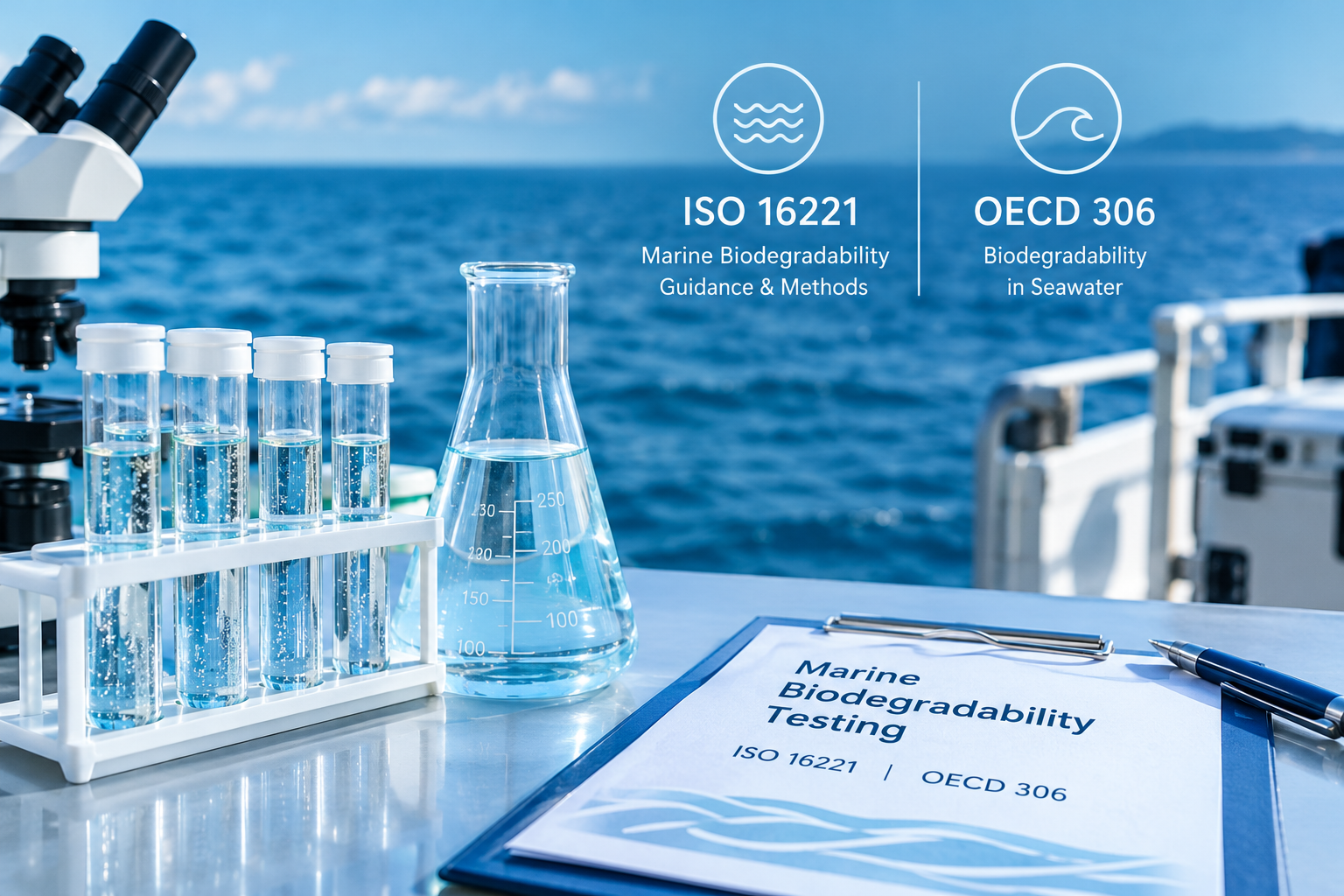
ISO 16221 and OECD 306 are two internationally recognized standards used to evaluate the biodegradability of organic substances in seawater. Although both address marine biodegradation, they differ in the test methods they describe and the options available for evaluating a material.
Understanding these differences can help organizations select an appropriate testing approach and interpret results accurately.
ISO 16221, Water quality — Guidance for determination of biodegradability in the marine environment, provides methods for determining the ultimate aerobic biodegradability of organic compounds in marine environments.
The standard adapts established fresh water biodegradation methods for use under marine conditions, using aerobic microorganisms in static aqueous test systems. Depending on the selected method and the properties of the test substance, biodegradation may be evaluated by measuring dissolved organic carbon (DOC) removal, oxygen consumption, or carbon dioxide (CO₂) production.
ISO 16221 is particularly relevant when organizations need to investigate the potential for ultimate aerobic biodegradation in marine environments rather than relying solely on data generated under freshwater conditions.
OECD 306, Biodegradability in Seawater, is a test guideline developed by the Organization for Economic Co-operation and Development (OECD). It evaluates the biodegradability of organic substances under aerobic seawater conditions.
OECD 306 describes two methods:
- Shake flask method
The test substance is introduced into seawater and incubated under agitation. Biodegradation is evaluated primarily through measurements of dissolved organic carbon. A reduction in DOC can indicate degradation, although the interpretation must account for factors such as adsorption and other potential losses.
- Closed bottle method
The test substance is incubated in sealed bottles containing seawater. Biodegradation is evaluated by measuring oxygen consumption as microorganisms break down the substance.
Unlike other screening methods, OECD 306 is specifically intended to obtain information about biodegradability in marine environments. Its results should be interpreted within that context.
ISO 16221 vs. OECD 306: What Is the Difference?
Both standards address ultimate aerobic biodegradation in marine environments, but their scopes are not identical.
ISO 16221 provides a broader selection tests, including tests based on DOC removal, oxygen consumption, and CO₂ evolution. OECD 306 provides two seawater-specific methods: the shake flask and closed bottle tests.
One important consideration is the measurement approach. DOC removal evaluates changes in dissolved organic carbon, while oxygen consumption and CO₂ production provide different measures of biological degradation. Each approach has advantages and limitations depending on the test substance and study objectives.
For example, an organization evaluating a material that contains volatile components may consider a closed bottle method. A CO₂ evolution method may be more appropriate when measuring carbon mineralization is a priority and the substance is suitable for that test system.
The standards should not automatically be considered interchangeable. Although some methods are technically related, the selected protocol, test conditions, and reporting requirements determine what conclusions the resulting data can support.
Why Does Marine Biodegradability Testing Matter?
Freshwater and marine environments differ in salinity, microbial communities, temperature, and other environmental characteristics. These differences can influence how microorganisms interact with and degrade organic substances.
Consequently, a material that demonstrates biodegradation under freshwater conditions may not exhibit the same degradation behavior in seawater. Marine biodegradability testing provides additional information about a substance’s behavior under defined marine test conditions.
This information may support research and development, environmental assessments, ingredient evaluation, and decisions about which testing methods are appropriate for a product’s intended application.
However, a laboratory biodegradation result does not establish that a product will degrade at the same rate in every ocean, coastal environment, or real-world disposal scenario. Nor does a biodegradability result alone establish that a product is harmless to aquatic organisms.
Organizations should consider the complete environmental profile of a material, including toxicity, exposure, and the relevance of the selected test conditions to the intended use.
How Do You Choose the Right Marine Biodegradability Test?
Selecting between ISO 16221 and OECD 306 begins with defining the purpose of the study.
Consider the following questions:
- What are the material’s properties? Solubility, volatility, composition, and potential inhibitory effects can influence method suitability.
- What measurement is needed? DOC removal, oxygen consumption, and CO₂ production provide different types of information.
- Are there specific customer or regulatory requirements? Confirm the required standard, test method, reporting format, and any acceptance criteria before initiating testing.
- What conclusions must the data support? The test should be selected to address the actual scientific question rather than simply choosing the most familiar standard.
A qualified biodegradability testing laboratory can review these considerations and help identify a suitable testing strategy.
Work With RespirTek for Marine Biodegradability Testing
Selecting the appropriate biodegradability test is an important step toward generating meaningful environmental data. ISO 16221 and OECD 306 offer established approaches for investigating the aerobic biodegradability of organic substances under marine conditions, but the best choice depends on the material, study objectives, and applicable requirements.
Selecting the right marine biodegradability testing approach is a crucial step toward understanding how a material may break down in aquatic environments. At RespirTek, our ISO/IEC 17025:2017-accredited laboratory provides biodegradability, compostability, and environmental testing services to help businesses evaluate materials using applicable OECD, ASTM, and ISO methods, including marine biodegradability testing. Throughout each project, we keep clients informed with regular updates on testing data progression and results. Contact RespirTek to discuss your material, explore the appropriate testing options, and learn how scientifically sound data can support your product development and environmental objectives.