As manufacturers and product developers place greater emphasis on environmental performance, reliable biodegradability data has become increasingly important. Whether evaluating a chemical, lubricant, polymer, formulation, or other organic material, selecting the appropriate testing approach is essential for obtaining meaningful results.
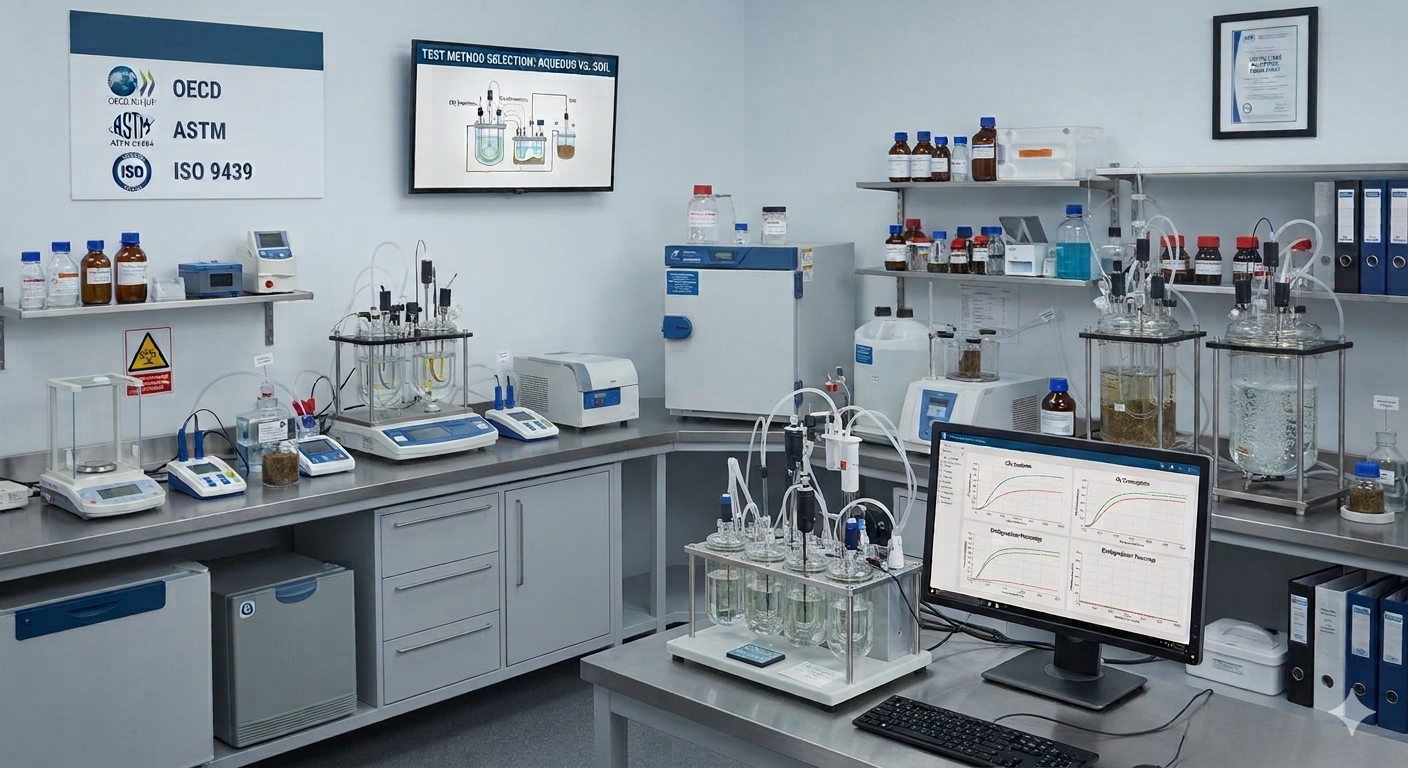
Biodegradability testing labs use standardized laboratory procedures to evaluate how materials are degraded by microorganisms under controlled environmental conditions. Depending on the material and the intended application, different biodegradability tests may evaluate degradation in aqueous environments, soil, compost, or other conditions.
Choosing the appropriate test method is not simply a matter of selecting a commonly used standard. The physical and chemical characteristics of the test material, the desired environmental claim, and applicable regulatory or customer requirements should all be considered before testing begins.
What Do Biodegradability Testing Labs Evaluate?
Biodegradability testing generally measures the ability of microorganisms to break down an organic substance under defined environmental conditions.
Depending on the test method, degradation may be evaluated by measuring various parameters. For example, the OECD 301 series includes six methods for evaluating ready and ultimate biodegradability in aerobic aqueous environments. These methods use different measurement approaches, including dissolved organic carbon removal, carbon dioxide evolution, oxygen depletion, manometric respirometry, and other indicators of microbial activity.
The test conditions are controlled so that results can be evaluated against defined criteria. This makes standardized testing particularly useful when laboratory data are needed to support product development, technical documentation, regulatory submissions, or environmental claims.
Common Biodegradability Tests
There are numerous standardized methods available, and the most appropriate method depends on the material and testing objective.
OECD Biodegradability Tests
The OECD 301 series is widely used for evaluating ready and ultimate biodegradability. Methods within the series include OECD 301B, which measures carbon dioxide evolution, and OECD 301F, which evaluates oxygen uptake using manometric respirometry.
OECD 310 is another ready and ultimate biodegradability method that measures carbon dioxide produced in sealed vessels.
ASTM Biodegradability Tests
ASTM standards provide additional approaches for evaluating biodegradation. ASTM D5864, for example, determines the aerobic aquatic biodegradation of lubricants or lubricant components by measuring evolved carbon dioxide.
ISO Biodegradability Tests
ISO standards provide internationally recognized methods for evaluating biodegradation using various analytical approaches. Depending on the material and testing objective, ISO methods may evaluate carbon dioxide evolution (e.g., ISO 9439), oxygen consumption (e.g., ISO 9408), dissolved organic carbon removal (e.g., ISO 7827), or related parameters.
Why Test Method Selection Matters
One of the most important steps in a biodegradability study occurs before the laboratory test begins: selecting an appropriate test method.
Because different standards are designed for different applications, biodegradability testing labs should evaluate the characteristics of the test material before recommending a specific method. Factors such as water solubility, volatility, physical form, chemical composition, concentration, and expected biodegradation behavior can affect which procedure is appropriate.
An appropriate biodegradability test should also be selected based on the intended disposal route of the test material and any applicable regulatory considerations.
For these reasons, simply requesting a particular test because it is commonly used may not always produce the most useful information. An experienced laboratory can review the material and intended objective and help determine which available method is most appropriate.
What Should You Look for in a Biodegradability Testing Laboratory?
When comparing biodegradability testing labs, it is important to consider more than just pricing. The laboratory’s accreditation, technical capabilities, experience with the applicable standards, and ability to communicate clearly throughout the project can all be important.
An ISO/IEC 17025-accredited laboratory has demonstrated that its laboratory activities operate within an established system for competence and quality. It is also important to verify that the specific method or testing service being requested falls within the laboratory’s accredited scope when accreditation is required for the project.
Clients should also ask whether the laboratory has experience with their particular type of material. A laboratory familiar with chemicals and water-insoluble substances, for example, may approach a difficult-to-test polymer or complex formulation differently.
Biodegradability Testing for Product Development and Environmental Claims
Biodegradability data can provide valuable information during product development. Testing may help manufacturers compare formulations, evaluate raw materials, investigate degradation behavior, or generate technical data for customers and regulatory purposes.
However, laboratory results should not automatically be interpreted as supporting every type of environmental claim. The meaning of a result depends on the specific test method, test conditions, acceptance criteria, and intended claim.
Choosing the Right Biodegradability Testing Partner
The right laboratory should do more than perform a test and provide a report. Biodegradability testing labs should be able to help clients by understanding their testing objectives, identifying appropriate biodegradability tests, explaining applicable requirements, and providing scientifically sound data that can be interpreted in the proper context.
Whether the objective is evaluating a new chemical, comparing formulations, assessing a lubricant, supporting product development, or obtaining data for an environmental claim, the appropriate testing method should be selected based on the material’s characteristics and the specific objectives of the study.
Before beginning a biodegradability study, provide the laboratory with information about the material, its intended application, and the purpose of the testing. This allows the technical team to evaluate the available methods and establish testing conditions that are appropriate for the project.
If your company needs reliable biodegradability data, working with an ISO/IEC 17025:2017-accredited and experienced laboratory can provide confidence in the testing process and results. At RespirTek, we specialize in biodegradability, compostability, and related environmental testing, helping businesses obtain scientifically reliable data to support product development, regulatory requirements, and environmental claims. Our testing capabilities include applicable OECD, ASTM, and ISO methodologies, as well as aqueous biodegradability certification services. Our team provides comprehensive data progression updates throughout the testing process, keeping you informed every step of the way. Contact us today to discuss your testing needs and determine which biodegradability tests may be appropriate for your project.