As demand for environmentally responsible products continues to grow, organizations are looking for credible ways to demonstrate that their products can biodegrade. Biodegradability Certification can provide an independent, science-based way to verify that a material or product and its constituents meet defined biodegradability requirements and gives organizations documentation they can use to back biodegradability claims with confidence.
What Is Biodegradability Certification?
Biodegradability Certification is a formal assessment used to determine whether a product or material meets established requirements for biodegradability under a specific program. While the exact requirements may vary from program to program, a biodegradable certification program should evaluate a material or product and its constituents against defined biodegradability criteria to generate robust, defensible evidence for biodegradability claims.
Biodegradable certification can provide science-based verification of a material or product’s biodegradability; however, manufacturers and distributors should ensure that any biodegradability claims – including the use of a certification mark – comply with applicable local and national regulations and guidance.
Why is Biodegradability Certification Important?
While performing a single standardized biodegradability test on complex materials and formulated products can generate useful data, the results may not fully represent the biodegradability of all individual constituents within the mixture. In many biodegradability tests, the presence of persistent, non-biodegradable constituents can be masked by activity from the biodegradation of other constituents. It can also be challenging for manufacturers and distributors to easily and clearly communicate third-party validation of their products’ biodegradability to their customers when the scientific evidence of their claim is spread out across multiple sources and/or test results. RespirTek’s Biodegradability Certification programs were designed to address these challenges.
Key benefits include:
- Rigorous, constituent-level evaluation: The programs evaluate a product and its constituents for biodegradability, helping ensure that all ingredients (with limited exceptions for trace materials) are biodegradable rather than relying on a single whole-formulation test that could mask persistent components in complex mixtures.
- Clear customer communication: Through use of a certification mark, an easy, recognizable way for clients to communicate to their customers that their product is biodegradable is provided, reducing ambiguity.
- Stronger evidence for complex mixtures: It is especially useful for manufacturers and distributors of complex mixtures, providing rigorous scientific evidence of the product’s biodegradability that stands up to regulatory and market scrutiny.
- Supply-chain efficiency: For raw-material suppliers, certification can give downstream formulators an easier path to biodegradable certification, because the raw material has already been assessed and may not require additional testing in finished formulations.
Biodegradable Certification is more than a test result—it’s a structured approach to credible biodegradability claims.
Does Every Product or Ingredient Need Biodegradability Testing?
Not necessarily.
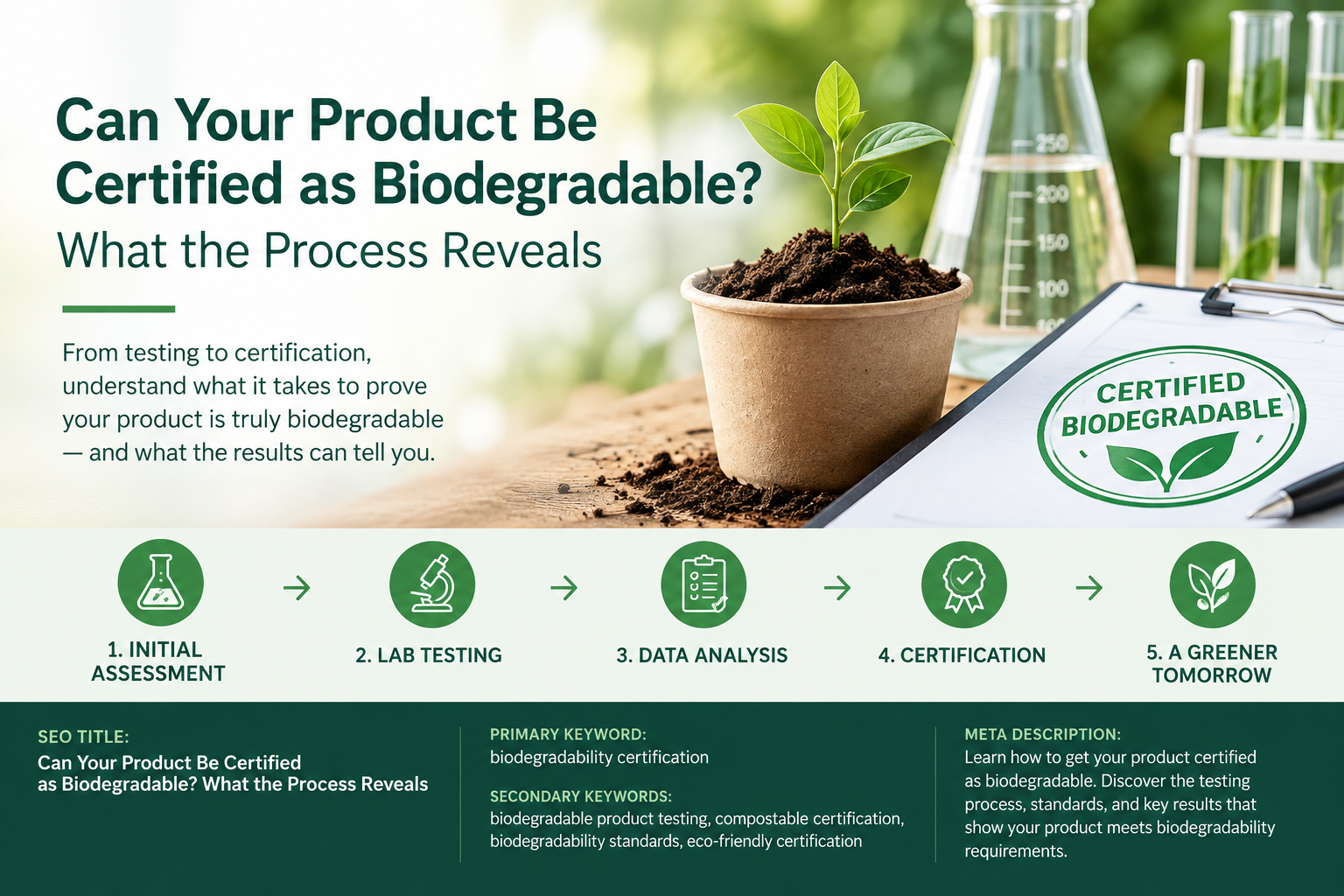
During a certification assessment, the material is first evaluated based on its ingredients and composition. The ingredients can then be reviewed against applicable national databases and recognized sources of information to determine what is already known about their biodegradability.
The assessment may ultimately lead to one of several outcomes:
- Existing information is sufficient and additional biodegradability testing is not required.
- Additional documentation or information is needed.
- Biodegradability testing is required to establish the necessary evidence.
This is one of the key advantages of a structured certification process. The need for biodegradability testing is determined based on the characteristics and composition of the material rather than assuming that every product must undergo the same testing.
What Does Biodegradability Testing Reveal?
When testing is required, standardized biodegradability methods can provide objective information about how a material behaves under specific environmental conditions.
Different tests answer different questions. Depending on the product and certification requirements, testing may evaluate characteristics such as:
- The rate at which a substance biodegrades
- The percentage of biodegradation achieved
- Whether biodegradation reaches an established threshold
- Whether microorganisms can utilize the material as a carbon or energy source
- Whether biodegradation occurs under specific environmental conditions
Methods such as OECD, ASTM, and ISO biodegradability tests and other standardized approaches may be appropriate depending on the material, its characteristics, and the objective of the evaluation.
Why Work with an Experienced Testing Laboratory?
When testing is required, working with an ISO/IEC 17025:2017-accredited laboratory can provide confidence that the testing is performed under a recognized quality system and according to applicable standardized methods.
An experienced laboratory can also help determine which testing approach is appropriate based on the material, its physical and chemical characteristics, and the intended purpose of the data.
For organizations, this can be especially important when the goal is not simply to obtain test results but to use those results as part of a broader certification or environmental claim.
Can Your Product Be Certified as Biodegradable?
The answer depends on the product, its ingredients, the available scientific information, and the requirements of the applicable certification program.
Importantly, Biodegradability Certification does not necessarily begin with a laboratory test. The process will begin with an assessment of the material’s ingredients against applicable national databases and other recognized information sources. That assessment determines whether existing evidence is sufficient or whether additional testing is needed.
If testing is required, standardized biodegradability testing can provide the scientific data necessary to evaluate the material. If existing information is sufficient, unnecessary testing may be avoided.
For organizations considering a biodegradable claim, understanding this process is the first step toward determining what evidence their product actually needs.
RespirTek provides ISO/IEC 17025:2017-accredited biodegradability testing and supports organizations seeking reliable scientific data for biodegradability evaluations and certification. We specialize in biodegradability certification, helping businesses confidently meet their testing goals while ensuring compliance with industry regulations. Our team provides comprehensive data progression updates throughout the entire testing process, keeping you informed every step of the way. Contact us today to take the next step toward obtaining biodegradability certification and improving your product’s environmental profile to make a more meaningful impact on global environmental sustainability.