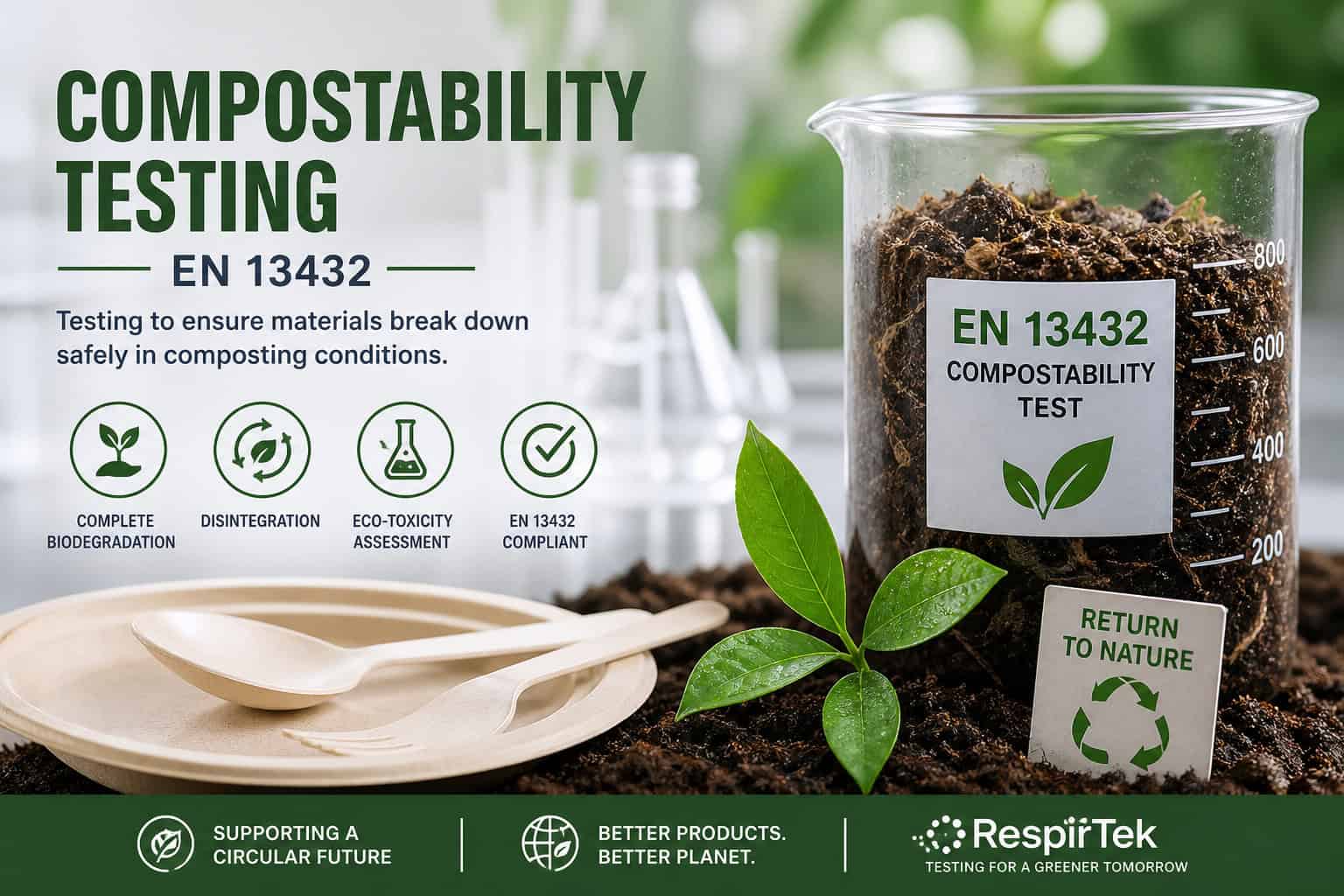
As sustainability continues to drive product innovation, businesses are under increasing pressure to ensure their materials are not only eco-friendly but also verifiably compostable. One of the most recognized standards in this space is EN 13432, a European benchmark that defines the requirements for packaging, recoverable through composting and biodegradation.
If your company develops biodegradable materials or pursues environmental certifications, understanding EN 13432 and the role of compostability testing is essential.
What is EN 13432?
EN 13432 is a European standard that specifies the requirements a material must meet to be classified as industrially compostable. It applies primarily to packaging materials and is widely accepted across global markets as a benchmark for compostability claims.
To comply with EN 13432, a material must meet strict criteria in four key areas:
- Biodegradability – The material must break down into carbon dioxide, water, and biomass.
- Disintegration – It must physically fragment during composting so that it is no longer visible.
- No negative effects on compost quality – The resulting compost must support plant growth.
- Low levels of heavy metals, inert materials, and other hazardous substances – Ensuring environmental safety.
These requirements are verified through a series of compostability testing protocols, making EN 13432 one of the most comprehensive standards available.
Why EN 13432 Matters
For organizations, EN 13432 is more than just a regulatory checkbox; it is a market enabler.
- Regulatory acceptance: Required in many European markets for compostable claims
- Consumer trust: Provides credibility and transparency
- Competitive advantage: Differentiates products in a crowded sustainability space
- Alignment with circular economy goals: Supports waste diversion and composting initiatives
Without proper certification, claims of “compostable” can be misleading and potentially non-compliant.
Key Components of Compostability Testing Under EN 13432
To achieve certification, materials must undergo a series of standardized compostability tests. These tests simulate industrial composting conditions and evaluate how the material behaves over time.
- Biodegradation Testing
This step measures how effectively a material converts into carbon dioxide under controlled composting conditions.
- Typically conducted using standards such as ISO 14855 or ASTM D5338
- Requires at least 90% conversion within 180 days when normalized against the positive control material
This ensures the material truly biodegrades rather than simply fragmenting into microplastics.
- Disintegration Testing
Disintegration evaluates whether the material physically breaks down during composting.
- Tested under simulated composting environments (e.g., ISO 20200)
- After 12 weeks, no more than 10% of the material may remain as visible fragments
This is critical for ensuring the material does not contaminate compost streams.
- Ecotoxicity Testing
Even if a material biodegrades, it must not negatively impact the quality of the compost.
- Plant growth tests (such as OECD 208) are conducted
- Compost derived from the test material must support healthy plant growth
This confirms the material is safe for agricultural and environmental use.
- Chemical Analysis
Materials are also tested for heavy metals, inert materials, and hazardous substances.
- Ensures compliance with environmental safety thresholds
- Prevents long-term soil contamination
Industrial vs. Home Composting
A common misconception is that EN 13432-certified materials will break down in any composting environment.
Important distinction:
- EN 13432 applies to industrial composting conditions
- These environments maintain:
- Elevated temperatures (typically 56-60°C)
- Controlled moisture and microbial activity
Home composting systems generally do not meet these conditions, meaning materials may not degrade effectively outside industrial facilities.
How Compostability Testing Supports Certification
Compostability testing is the foundation of EN 13432 compliance. Without rigorous testing, certification is not possible.
Testing laboratories perform:
- Controlled incubation studies
- Continuous monitoring of degradation
- Analytical verification of results
The outcome is a data-driven validation of compostability, ensuring that claims are scientifically supported and defensible.
Common Challenges in EN 13432 Testing
Achieving compliance is not always straightforward. Some common challenges include:
- Material complexity: Multi-layer or composite materials can be difficult to fully biodegrade
- Additives and coatings: May inhibit microbial activity
- Slow degradation rates: Materials may plateau below required thresholds
- Inconsistent disintegration: Physical breakdown may not meet criteria
These challenges highlight the importance of working with experienced laboratories and selecting the right test methods early in product development.
Who Needs EN 13432 Certification?
EN 13432 is particularly relevant for:
- Packaging manufacturers
- Bioplastics developers
- Consumer goods companies
- Food service product suppliers
- Brands entering European markets
If your product is marketed as compostable, especially in Europe, EN 13432 certification is often expected or required.
Final Thoughts
As sustainability standards evolve, EN 13432 remains a cornerstone for validating compostability claims. Its rigorous requirements ensure that materials not only break down but do so safely and effectively within industrial composting systems.
For companies investing in eco-friendly innovation, compostability testing is not just a technical requirement; it is a strategic advantage. It builds trust, supports compliance, and positions your products for success in a sustainability-driven market.
If your company aims to achieve EN 13432 certification, collaborating with an ISO/IEC 17025:2017 accredited and experienced laboratory can streamline the process, reduce uncertainty, and provide expert guidance at every stage. At RespirTek, we specialize in biodegradability and compostability testing, helping businesses confidently meet their sustainability goals while ensuring compliance with industry regulations. Our team provides comprehensive data progression updates throughout the entire testing process, keeping you informed every step of the way. Contact us today to take the next step toward obtaining compostability certification and making a meaningful impact on environmental sustainability.