As consumers and industries increasingly seek environmentally responsible products, understanding how chemicals and formulations interact with wastewater treatment systems has become more important than ever. Products marketed as biodegradable, environmentally friendly, or safe for household use must still be evaluated to ensure they do not negatively impact biological treatment processes.
Septic-safety testing helps determine whether a product, ingredient, or chemical formulation may interfere with the microorganisms responsible for treating wastewater in septic systems and decentralized wastewater treatment units. These tests provide valuable insight into whether a product is compatible with biological wastewater treatment processes and can help support environmental claims with scientific data.
Two internationally recognized test methods commonly used for evaluating impacts on wastewater treatment microorganisms are OECD 209 and OECD 224.
What Is Septic-Safety Testing?
Septic systems rely on naturally occurring microbial communities to break down organic matter and treat wastewater. These microorganisms are essential for maintaining proper system performance. When certain chemicals, cleaning agents, additives, or other substances enter a septic system, they may inhibit microbial activity and reduce treatment efficiency.
One important factor in septic-safety testing is the evaluation of whether a product has the potential to negatively affect these biological processes.
This type of testing can help answer important questions, including:
- Does the product inhibit beneficial wastewater microorganisms?
- At what concentration does inhibition occur?
- Is the product compatible with biological wastewater treatment?
- Could repeated use of the product impact septic system performance?
Not only are these evaluations particularly important aspects of septic-safety testing, but they are also important for products intended for household use, agricultural applications, industrial discharge, and environmentally sensitive applications.
OECD 209 Activated Sludge Respiration Inhibition Test
The OECD 209 Activated Sludge Respiration Inhibition Test is one of the most widely used methods for evaluating the potential inhibitory effects of chemicals on microorganisms found in aerobic wastewater treatment systems.
The test measures the effect of a test substance on the respiration rate of activated sludge microorganisms. Because aerobic microorganisms consume oxygen as they metabolize organic material, a reduction in oxygen consumption can indicate that a chemical is inhibiting aerobic microbial activity.
During an OECD 209 study:
- Activated sludge microorganisms are exposed to different concentrations of the test substance.
- Oxygen consumption rates are measured.
- The respiration rate of treated samples is compared with that of untreated controls.
- The concentration causing a specified level of inhibition is determined.
The results can help determine whether a product may interfere with biological wastewater treatment processes.
Although OECD 209 was originally developed for municipal wastewater treatment applications, the principles are also relevant when evaluating products that may enter septic systems.
OECD 224 Determination of the Inhibition of the Activity of Anaerobic Bacteria
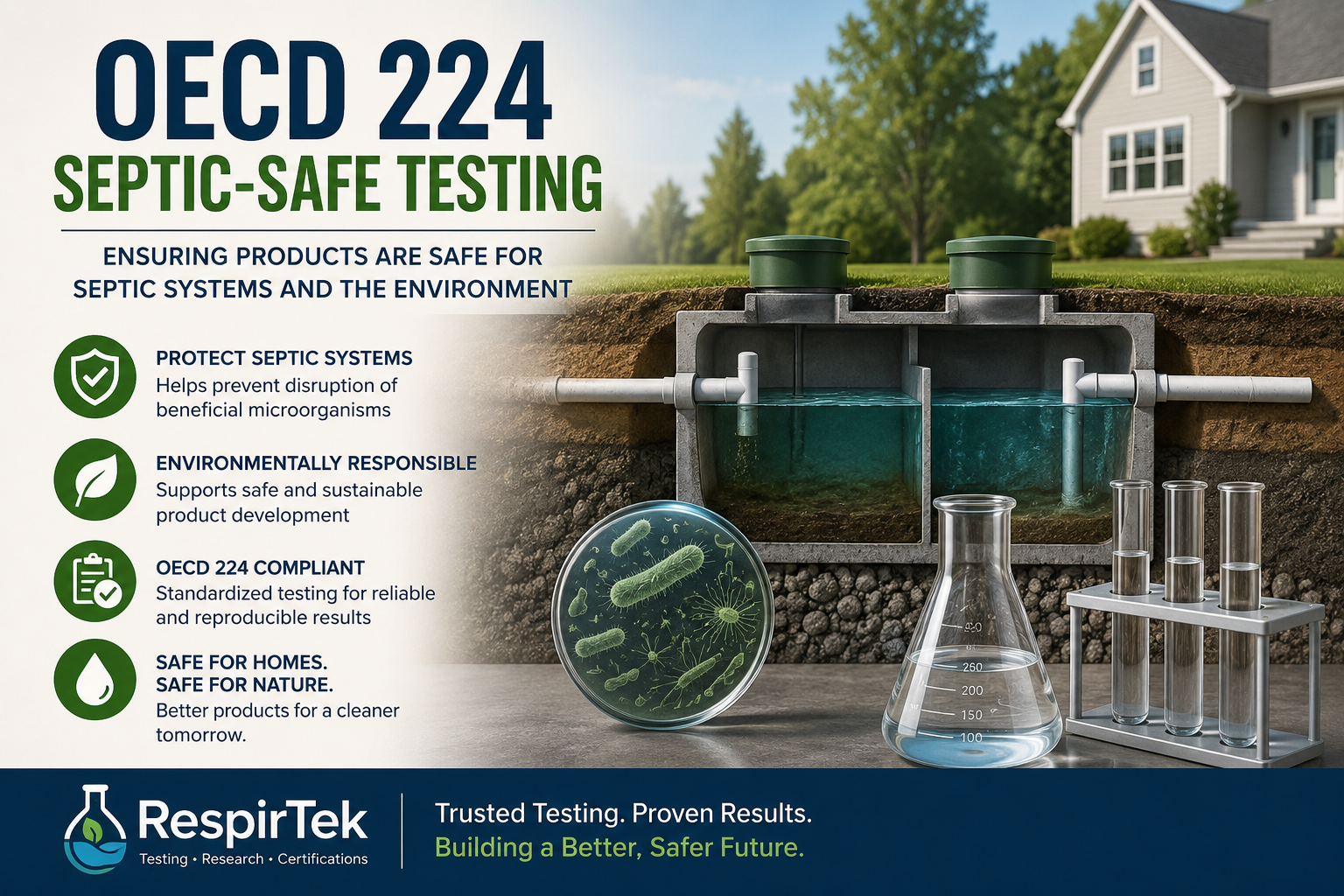
The OECD 224 Anaerobic Digestor Sludge, Gas Production Inhibition Test provides a more specific evaluation of how chemicals may impact anaerobic microorganisms in conditions common to septic systems.
The test measures the effect of a test substance on the respiration rate of anaerobic digester microorganisms. Because anaerobic microorganisms produce methane, carbon dioxide, and other biogases as they metabolize organic material, a reduction in gas production can indicate that a chemical is inhibiting anaerobic microbial activity.
The test evaluates:
- The impact of a substance on anaerobic microbial activity
- Potential effects on sensitive microbial populations
- Concentrations where inhibition occurs
- The ability of microorganisms to maintain normal treatment activity
Because anaerobic bacteria are highly sensitive to certain chemicals, OECD 224 can provide additional information beyond that of general microbial respiration testing.
Why Is Septic-Safety Testing Important?
Many products are introduced into septic systems every day, including:
- Cleaning products
- Laundry additives
- Personal care products
- Degreasers
- Drain cleaners
- Biodegradable materials
While biodegradability is an important environmental characteristic, a product being biodegradable does not automatically mean it is safe for biological wastewater treatment systems.
A product may biodegrade but still potentially inhibit microorganisms during use. Conversely, some substances may have low biodegradation but minimal impact on microbial activity. Septic-safety testing provides the data needed to better understand these interactions.
Supporting Environmental Claims with Scientific Data
Companies developing environmentally responsible products often need more than marketing statements to demonstrate sustainability. Independent laboratory testing provides scientifically supported information that can strengthen environmental claims.
Combining biodegradability testing with septic-safety testing can provide a more complete understanding of a product’s environmental profile.
For example:
- Biodegradability testing evaluates how microorganisms break down a product.
- Septic-safety testing evaluates whether the product negatively affects those microorganisms.
Together, these studies provide a more comprehensive assessment of environmental compatibility.
Choosing the Appropriate Septic-Safety Testing Approach
The appropriate test method depends on the intended application, product composition, regulatory requirements, and environmental claims being evaluated.
OECD 209 may be appropriate when the goal is to evaluate general microbial inhibition, while OECD 224 may be selected when understanding potential effects on anaerobic bacteria is important.
In some cases, additional wastewater treatability studies may provide further insight into product behavior under simulated treatment conditions.
Selecting the right testing lab is critical to ensuring high-quality, defensible results. When choosing a lab, consider the following factors:
- ISO/IEC 17025:2017 Accreditation – Ensure the lab has ISO/IEC 17025:2017 certification and that this testing protocol is listed on their scope of accreditation. This ensures standardized procedures and data integrity.
- Technical Expertise – A specialized lab can guide test selection, study design, and result interpretation
- Consultative Approach – The best labs provide insight into how results align with regulatory and marketing goals, not just raw data.
- Customer Support & Data Transparency – Look for a lab that prioritizes clear communication and provides real-time data progression updates. Receiving interim results throughout the testing process ensures timely insights, allowing your company the ability to make informed decisions.
Conclusion
Septic-safety testing plays an important role in evaluating whether products are compatible with biological wastewater treatment systems. By using internationally recognized methods such as OECD 209 and OECD 224, companies can better understand how their products interact with wastewater microorganisms and support responsible environmental claims.
As demand grows for sustainable products, demonstrating both biodegradability and wastewater compatibility will continue to be an important part of environmental product development.
If your company aims to achieve septic-safety testing, collaborating with an ISO/IEC 17025:2017 accredited and experienced laboratory can streamline the process, reduce uncertainty, and provide expert guidance at every stage. RespirTek provides biodegradability, wastewater treatability, and microbial inhibition testing services to help companies evaluate the environmental performance of their products through scientifically validated laboratory studies. Our team provides comprehensive data progression updates throughout the entire testing process, keeping you informed every step of the way. Contact us today to take the next step toward testing and improving your product’s environmental profile and making a meaningful impact on global environmental sustainability.